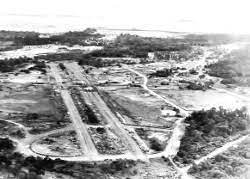
Only on arrival at our campsite we discovered that the advance party sent to construct our camp had been moved to build accomodation for 2 flying Squadrons so both campsite and work area a few miles down the road were bare patches in the Kunai Grass.
Our first night in New Guinea was open sleeping under the stars, fortunately our tents and stretchers were unloaded first so we had a stretcher to sleep on.
Next day was a hive of activity, timber which we had brought with us enabled all tents to have a floor approx 18” to 2 feet above the ground. With approximately 300 men on site this proved an easy task as tents were set out in lines, I think it was 12 tents per line with 6 personnel to each tent. Everybody was under cover before the heavy tropical storms hit.
As only surface water was available and proved very unsatisfactory, Bores were sunk and water was pumped to overhead tanks with square ships tanks on top. Showers and ablution blocks were constructed with concrete floors. As this took some time 44 Gal drums (200 litres) were placed in rows at the end of tent lines. Quite a site as the boys trooped down in the raw soaped up and then your mates threw buckets of water over you to wash soap off.
Work went on at a frantic pace when mess halls for Airmen, sergeants, and officers, a huge kitchen, and hospital with 12 beds were built. We put wooden frames up pitched roof of iron and walls were of sisalkraft paper and gauze wire which proved very satisfactory. All this was carried out with materials brought with us due to the foresight of our CO and equipment officers. Also the K.V.A. [generator] which we brought with us allowed 1 single bulb to each tent so that we had electricity till lights out at 10pm each night. All this was completed in 2 to 3 weeks and our attention turned to our working areas.
The working areas were situated about 3 miles down the road towards Lae at the end of an airstrip. It had area for workshops and several parking bays in which planes could be parked before or after servicing.
Our section had the job to construct a complete sawmill. It consisted of a large circular saw, KVA generator to drive the electric motors and a swing docking saw plus a working area to pack machinery for dispatch. It had an iron roof and hessian walls for protection which we drop down whilst working. Also a small secure building was built for our W.O. Engineer McKenzie to carry out his work.
Equipped with a D4 Caterpillar tractor to haul logs to our mill, it was often rather hazardous as in in the jungle were craters formed by bombs. These were filled with a slimy mess of rubbish and when our tractor headed into one it was wholly or partially submerged. It was hard work to extricate these machines but fortunately they suffered little damage.
Another hazard were the clumps of prickly Wait-a-while ferns. Clumps were several feet across and up to six feet high with each frond lined with hook-like thorns. They gave you a nasty cut or scratch which if not treated immediately turned into nasty sores.
Another danger were large trees which stood alone on a track, they were ideal for target practice as you passed by. Often a few cuts with the axe and they would topple over as they had so many bullets in them to almost cut the tree through. Also our circular saws did not take kindly to the armour piercing bullets embedded in the trunk.
We were kept extremely busy working long 12 or 14 hour days unpacking spares for the Kitty Hawks in for repair and crating engines to be returned to mainland for complete overhaul. This went on six days a week with Sunday usually a rest day but not always.
There was little variation to the routine livened up sometimes with a visit from Jap recon planes, a liberator crashing and exploding within a 100 yards of our workforce, a thunderbolt and a lightening fighter planes cutting one another in half during exercises and landing on the edge of our area.
Also the liberator bombers would come back from missions with parts of wings and fuselage missing and unable to land. They would do a circle of the strip then the crew would jump two at a time. The pilot would be last to jump and before he left the plane it would be set on auto pilot and headed for the mountain. Immediately a fighter Squadron would scramble and engage in a little shooting practice.
Twice we had crippled planes come down within a close proximity to our working area exploding on impact injuring several of chaps who were bowled over by the blast from it.
The second landed on the road quite close to our sleeping area. The plane was supposed to be guarded by American G.I. but several fellows just walked past them to inspect the plane. One of these from our tent Dave – a real character and sawmill from near Casino. He climbed up to rear turret and waved to us on the ground. At that moment a spark set the whole plane on fire. Dave jumped from the turret hit the ground and took off down the road with his hands clutching the cheeks of his behind. Unfortunately this triggered a mental collapse. Next day after treating us to a display of waving his arms at a spinning circular saw, he took off into the jungle. It took us about two hours to find him hiding in the middle of a huge Wait-a-While bush. As we hacked at it to get him out he would retreat further into it. He was taken to Hospital and repatriated home but he caused chaos on the way home, at Port Moresby aerodrome he and another chap escaped from their restrictive harness, jumped out of the plane and took off down the centre of the strip and were lucky not to be mowed down by a plane landing.
Leave a Reply
You must be logged in to post a comment.